Infrastructure Automation
Infrastructure that rebuilds itself the same way every time
Provisioning by hand is slow, and worse, it’s inconsistent — environments drift until nobody can say what production actually looks like. We turn that work into versioned code you can review, test and roll back.
The idea
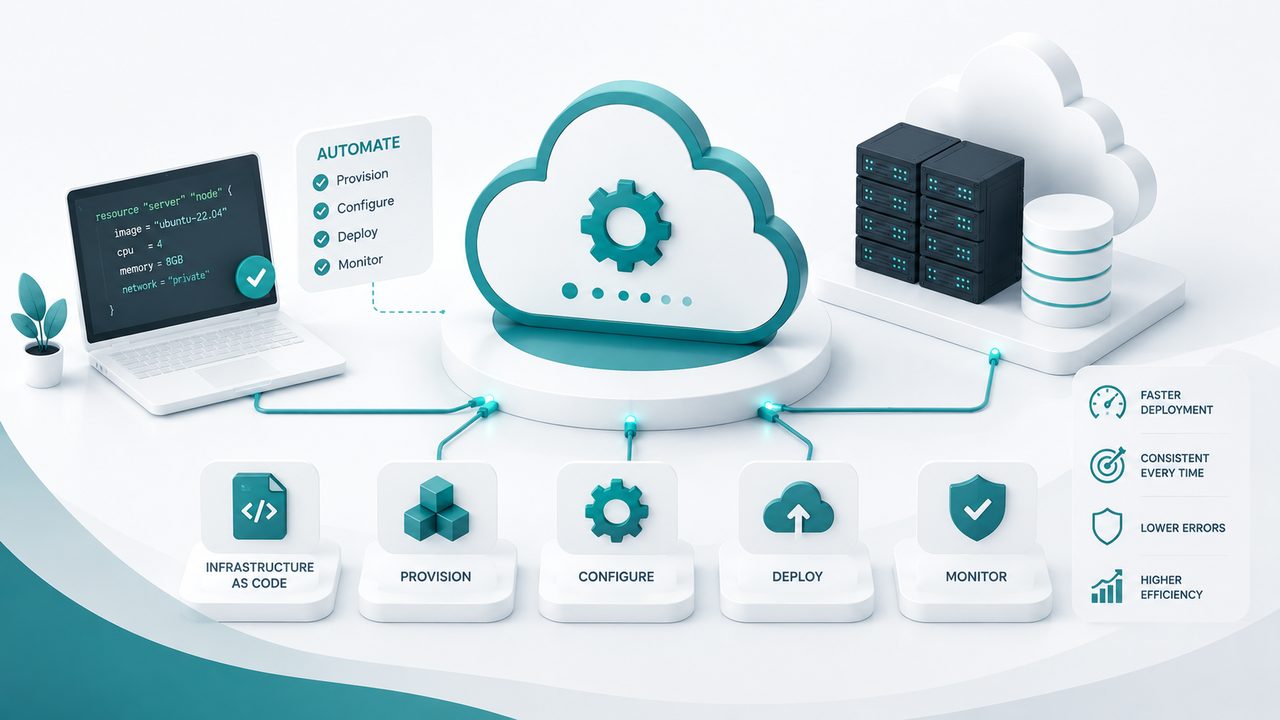
Infrastructure as code, meant literally
- Repeatable: the tenth environment matches the first
- Reviewable: changes go through the same process as application code
- Reversible: a bad change is a revert, not an outage post-mortem
Environments stop being artefacts that someone assembled once and nobody dares touch.
Toolchain
The tools, and what each is actually for
Provision
Make it exist.
- Terraform
- Declares cloud and virtual resources, and shows the plan before it changes any.
- MAAS
- Bare metal behind an API: discovery, commissioning and OS install on physical servers.
- Cloud APIs
- Called directly where the provider’s own interface is the shortest route.
Configure
Make it match the definition.
- Ansible
- Idempotent playbooks — run one again and the machine returns to its declared state.
- Juju
- Charmed operators that deploy, then keep operating, OpenStack and Kubernetes.
- Cloud-init
- First boot only: users, keys, packages and network, before anything else.
Govern
Make every change accountable.
- Git & GitOps
- The repository holds the desired state; environments reconcile to it, not to hand edits.
- Policy as code
- Rules that run in the pipeline, so a change that breaks them fails before it lands.
- CI pipelines
- Plan, test and apply run the same way for everyone. No laptop is a deployment tool.
Scope
Where automation pays for itself
- ProvisioningCreate, configure and scale infrastructure from reusable templates rather than a runbook and a coffee.
- Configuration managementSystems held at a declared state with Ansible or Juju, so drift is corrected instead of discovered.
- PipelinesAutomation wired into CI/CD, so infrastructure changes ship the same way application changes do.
- Compliance automationHardening, patching and audit controls embedded in the workflow rather than applied afterwards.
- Environment parityDev, test and production built from the same definitions, so ‘works on staging’ means something.
- Multi-cloud & hybridOne consistent way of working across public, private and edge, instead of three sets of habits.
In practice
Standing up a cloud without standing over it
A production-grade environment in hours rather than days, and identical on the second attempt.
- Provisioning servers configured through MAAS or cloud APIs
- Clusters OpenStack or Kubernetes deployed from declarative blueprints
- Integration networking, storage and monitoring wired in automatically
- Hardening security and compliance baselines applied as part of the build
Why NubeStack
Automation you can inherit
Modular, not monolithic
Composable modules your team can extend, rather than one enormous playbook only its author understands.
Written to be read
The code is a handover artefact. If your engineers can’t follow it, we haven’t finished.
Across the whole estate
Terraform, Juju, MAAS, Ansible, Kubernetes and OpenStack — the same discipline from bare metal upwards.
Tell us what you're still doing by hand
Provisioning, patching, cluster builds, environment setup — we'll tell you which of them are worth automating and which genuinely aren't.